

CFD trading, or Contracts for Difference trading, is where you trade on price movements without owning the underlying asset. CFDs are popular because they allow small investors to access markets without buying the full asset.
Understanding key terms like pips, lots, and spreads is essential for calculating your trade size, potential profits, and costs. In this guide, we’ll break down the basics and give you clear examples so you can start trading CFDs with confidence.
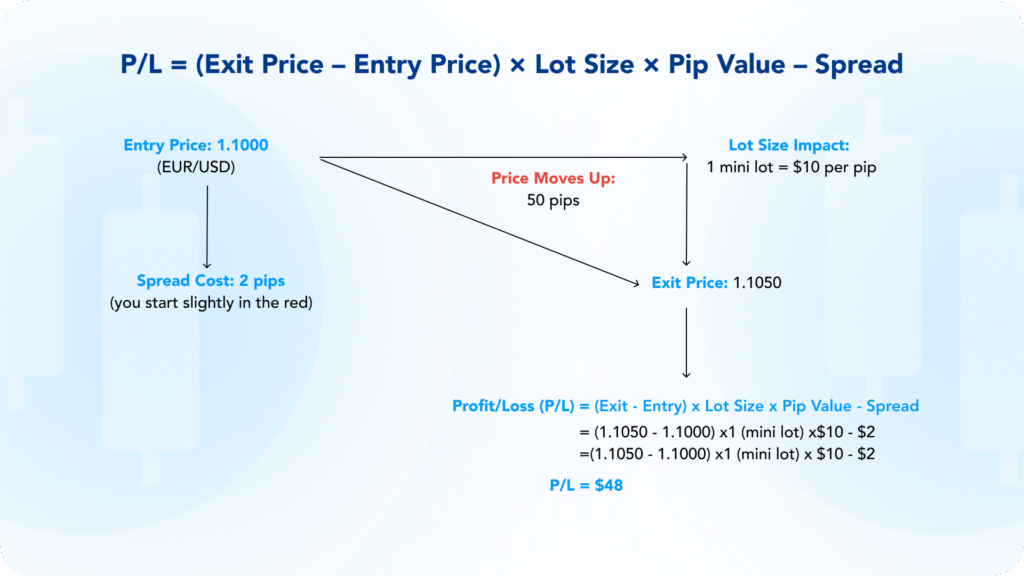
 This diagram helps you visualize the relationship between pips, lots and spreads:
What a CFD Is and How It Works
A CFD is a financial derivative that allows you to speculate on the price movement of an asset like stocks, forex, commodities, or cryptocurrencies without actually owning it.- How it works: You agree to exchange the difference in the asset’s price between the time you open and close the trade.
- Key benefit: You can profit from both rising and falling markets.
Understanding Pips, Lots, and Spreads
Pips = The Smallest Price Movement
A pip (percentage in point) is the smallest unit of price movement in a market. For most forex pairs, 1 pip = 0.0001 of the currency pair. Example: If EUR/USD moves from 1.1000 to 1.1005, that’s 5 pips. Pips vary by market: in commodities like gold, the smallest move may be 0.01. Understanding this helps you calculate profits or losses accurately.Lots = Your Trade Size
A lot is the standardized quantity of the asset you are trading. Common sizes:- Standard lot = 100,000 units
- Mini lot = 10,000 units
- Micro lot = 1,000 units
Spreads = The Cost Of Trading
The spread is the difference between the buy (ask) and sell (bid) price. Example: If EUR/USD bid = 1.1000 and ask = 1.1002, the spread is 2 pips. Why it matters: You start your trade slightly “in the red” because of the spread. Narrower spreads reduce costs.Trade Example: How Pips, Lots, and Spreads Affect Your Trade
Here’s a simple CFD trade showing how entry and exit prices, pip movement, lot size, and spread affect profit or loss.
This diagram helps you visualize the relationship between pips, lots and spreads:
Common Beginner Mistakes in CFD Trading
- Confusing CFDs with owning the asset. CFDs do not give you ownership rights.
- Ignoring the spread (small costs can add up over many trades).
- Trading too large lots relative to your account size.
- Assuming leverage is free money (it magnifies both gains and losses).
- Believing past price movements guarantee future results.
Key Risks to Know Before Trading CFDs
- Leverage magnifies losses: Even a small market move against you can result in significant losses.
- Market volatility: Prices can swing quickly, especially in crypto or commodities.
- Platform/account risks: Make sure your broker is regulated and reputable.
Using MT4/MT5 for Your CFD Trades
Most CFD brokers offer MT4 or MT5, which let you:- Open/close trades quickly
- Monitor pip movements in real-time
- Calculate potential P/L based on lot size and spreads
Frequently Asked Questions About CFDs
Q: Can I lose more than my deposit with CFDs? A: With proper risk management and stop-losses, you can limit losses to your account balance. Q: Do I own the underlying asset when trading a CFD? A: No. You only speculate on the price movement. Q: Do I need a big account to trade CFDs? A: Small accounts are fine if you manage lot sizes carefully and use risk controls. Q: How do I calculate potential profit or loss? A: Multiply pip movement × lot size × pip value. Your platform usually calculates this automatically.Related Articles and Further Reading
- Leverage, Margin & Slippage: How They Affect Your CFD Trades
- Trading Risks & Safety: Why Traders Lose and How to Protect Your Capital
- Risk-to-Reward Ratios & Practical Strategies: Applying Risk Management in Real Trades